Portrait of a Graduate (PoG)
A school- or district-level framework that defines, in community-derived language, the skills and traits a graduating student should embody. Typically expressed as a small set of competencies (communication, critical thinking, collaboration, problem-solving, agency, adaptability, accountability) rather than as content-knowledge benchmarks.
PoG is one of the few mainstream approaches that explicitly frames "achievement" in terms of real-world capacities — college, career, civic, and personal life — rather than in terms of academic proficiency bands.
How it's structured (NGLC's version)
NGLC groups PoG competencies into four domains:
- Content Knowledge
- Creative Know How
- Habits of Success
- Wayfinding Abilities
Other PoG frameworks vary in vocabulary; the four-domain version is one organizing scheme among several.
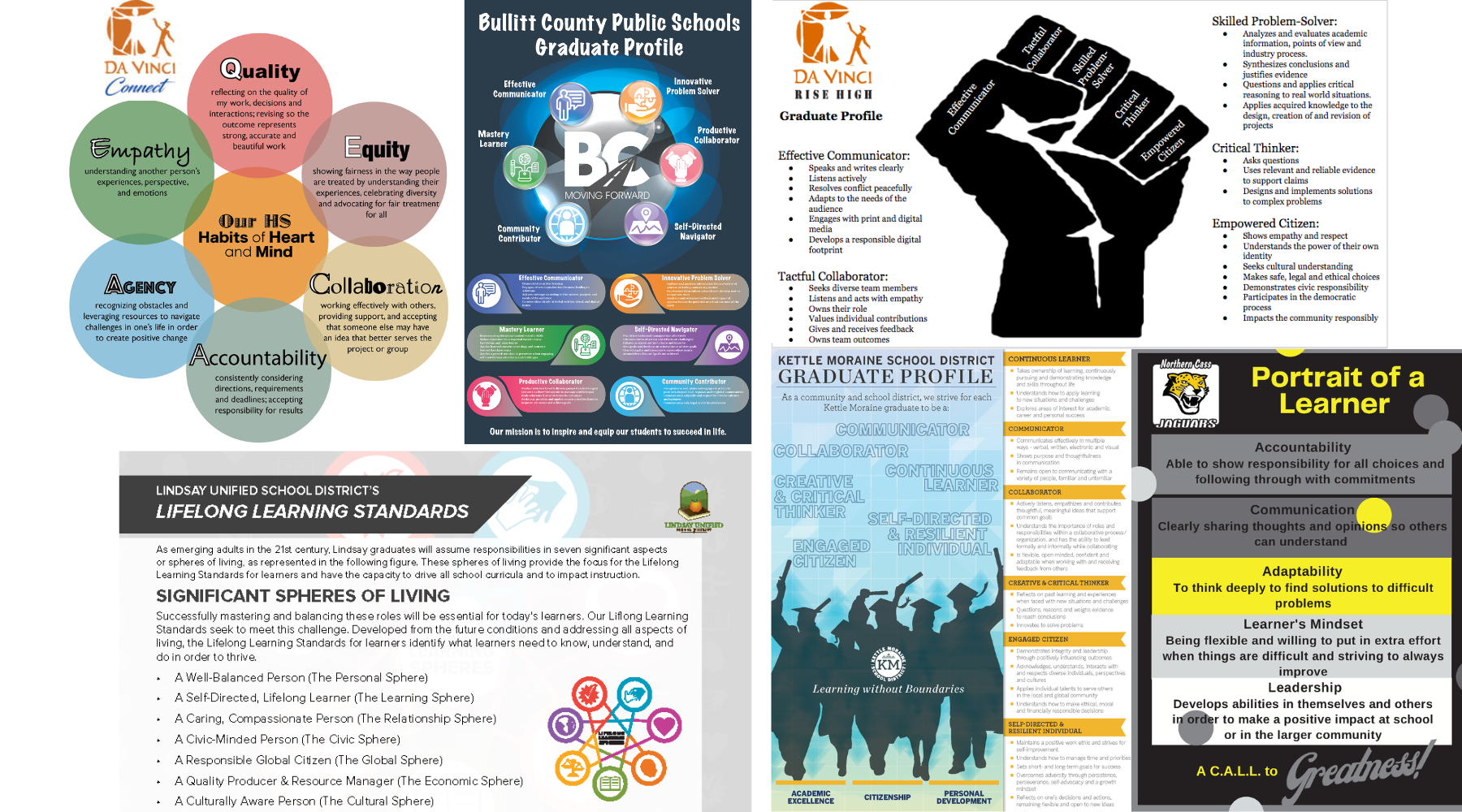 The visual form varies widely across districts (compass, wheel, multi-page document) while the underlying domain structure converges. Source: NGLC, "Portrait of a Graduate in Practice".
See NGLC PoG in Practice source for the framework in detail and the five district profiles that ship it.
Trade-offs
Where proficiency bands abstract a test score into a label, PoG starts from real-world capacities and works backward into evidence — projects, presentations, performance-based assessments, portfolios.
- Strength: competencies are intelligible to parents in a way "Approaches Standards" is not. "Critical thinking" maps to lived experience.
- Weakness — measurement. Competencies are notoriously hard to score reliably. Without standardized rubrics, PoG progress reports can be subjective.
- Weakness — comparability. Each district defines its own portrait; cross-district comparison is essentially impossible.
- Weakness — parent-reporting tooling. Public materials from PoG proponents are strong on framework definition and thin on the concrete digital portfolios, dashboards, or parent-facing competency reports that would make a PoG legible to families day-to-day. Vendors like SpacesEDU are starting to fill the tooling gap (district-defined PoG templates, multimedia evidence portfolios, live family-visible competency dashboards), but vendor marketing does not yet offer evidence that the affordance translates into improved parent comprehension.
Contrast with NCRC
ACT's NCRC is the workforce-credential answer to the same question — translate skills into a tiered, real-world-anchored signal. NCRC achieves portability and parent legibility at the cost of being vendor-defined and graduation-era only. PoG achieves community ownership and lifelong-skill framing at the cost of measurement rigor.
A tension worth tracking: these could be competing answers or complementary layers. Likely complementary in principle, but no published case describes a district that runs both PoG and NCRC and reports them together.
Follow-ups
- Independent (non-vendor-marketing) evidence of whether PoG portfolio tools like SpacesEDU actually improve parent comprehension of student achievement, vs. just shifting the form of the report.
- Other tooling-side vendors to investigate: Wayfinder, Unrulr, Defined Learning, Panorama Education, CAE.